Avskrift av
boken til Conrad Johan Zahl Hansen:
A Glance of My Life, Provo, Utah, 1971
(Kun de første sider som omhandler Kvitvær. K-LG 2009)
Place of Birth
My
life began in the arctic region of northern Norway, or to be accurate, where
the Arctic Circle intersects the west coast of Norway. This northern region is
well-known by tourists and travelers as the area of the midnight sun. This
fringy coast decorated with hundreds of islands makes an interesting design for
painters and poets who are seeking inspiration and the perfect setting for a
personal artistic work. High mountains stand firmly above the sea, watching the
lower islands scattered around them a11 along the coast. The islands come
generally in groups, and each group has a name according to the appearance and
size. Each strip of ocean has a name, if for no other purpose but to aid the
government in making maps for the transportation along the coast. The names
have changed a trifle during the past centuries, but merely to conform with the
style of the later inhabitants. One group has bleach-white rocky reefs, and
perhaps originated the name Kvitver (White Group). At this place I was born,
and lived with my parents and their people during childhood and youth. This
group is small and not very prominent, but is located close to the main route
of traveling going north and south.
The
main island of Kvitver is approximately three (3/4) miles long, and nearly as
wide, with several smaller islands closely connected to the main island on
every side. These islands are hilly, and the summit of the highest hills gives
an extensive view over the ocean in all directions. The indentation of the
shores into nooks and corners makes the island well-adapted for landing small
boats and for erecting boathouses. There is also a convenient and safe harbor,
surveyed by the government for entering and anchoring large vessels.
During
the year it rains considerably, so fresh water is not a problem. The main
island has therefore many glittering ponds. But on this windy island, there is
not any forest. No, not a single tree has ever grown enough to be called
anything else but a bush. The green grass and wild flowers decorate the hills
and meadows sufficiently during the summer season to satisfy the people living
there, and we never longed for shade trees or forest. Neither did we have such
sensations as the wind rustling in the tree tops. Our neighbor did plant one tree,
and in forty years, when I returned from foreign lands, it was as tall as a
one-story house.
Yes,
this is the land of the midnight sun. Through the lustrous evenings and
mornings the sun moves slowly through drifting clouds and produces grotesque
sceneries. The glorious summers therefore attracted people from many places for
a brief summer vacation.
But
northern Norway also has long and dark winters. The winter is often twice as
long as the summer. However, the spring weather changes quickly from winter to
spring. Violent storms and short days are not inviting features for tourists
and travelers. Were it not for the moderation of the ocean it would be bitterly
cold. The current bearing north keeps the icebergs away from the coast, and
this moderates the climate considerably.
In
many ways it has been a pleasure to have lived in such a beautiful land, and to
have personally known such noble people as my early associates, and my
honorable ancestors, who lived for centuries under these extremely changing climatic
conditions on these scattered islands along the coast.
My
Parents
In
writing about my parents I shall begin with my father, who was two years older
than my mother, not merely in years, but also in the art of sailing his toy
boat in a shallow washtub, till his determined mother called: "Now Hans!
What are you up to?" This advancement in time lasted all their life, till
my mother decided to get even with him, as she lived two years longer. They
both died at the age of 62, without a divorce, and without any praise at their
funeral services.
My
father, Hans Kristian Jorgensen, was born on the 12th day of September, 1844,
at the island of Nord-Solver (North-Sun-Group), a neighbor island west of
Kvitver. This island has three farms, a general store, and a post office, but
no doctor or trained nurse in the district. My father was the fifth child of a
large family of 12 children. His parents owned a farm, and were therefore in
moderate financial circumstances.
Then
something grievous happened. My father and my grandfather rowed two boats
around their island. A violent windstorm arose, and my father drifted to a
small island and leaped ashore. The boat was damaged, but he was rescued. My
grandfather rowed the largest boat, and was unable to handle it properly, so he
drifted towards the open sea and never returned. He was then 60 and my father
was 21. The church record of Luroy Parish states that my grandfather, Jorgen
Johan Mortensen, drowned on the 17th of May, 1865, and that his burial took
place August 13th the same year, indicating that the corpse was found in the
summer of 1865. He had, therefore, a decent burial, which was highly
appreciated. My grandmother, Ane Elisabeth Christoffersen, was then 47 years
old, and had ten living children. The youngest was only two years old, but the
three oldest children were married, and my father, being the oldest of the
seven children at home, helped his mother with farming and fishing for several
years.
Sometime
after my grandfather's death, my grandmother married Kasper Hansen, from the
city of Bodø. He was attracted to this island by a herbalist. He was ten years
younger than grandmother, and the inducement was that he would be a great help
to her, for she owned a farm and home. But evidently he was not in good health,
as he died many years before my grandmother.
My
father was not badly needed at home then, so he began to plan for his own
future.
My
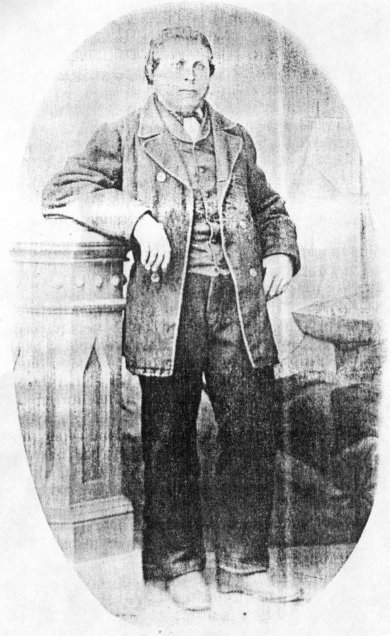
father was a practical man, not very large, as I remember him about five feet
and eight inches tall, and approximately 165 pounds. He wore a short beard, as
this was in vogue at that time, and he was of fair complexion. He had trouble
with his suspenders to make them stay on his sloping shoulders. He was
talkative and pleasant in his crowd. His scholastic education was limited, yet
he could write legible and interesting letters, and read fluently. In his
social functions he was modest, and did not drink intoxicating liquor, neither
did he use tobacco in any form, which was unique at his time.
At
the age of 26 he married my mother from the island of Kvitver. They were not
related, but attended the same school and the same church. I know very little
about their courtship. They maintained enduring love without much display.
Affection was not on exhibition among the people in the district, neither was
it considered graceful manners to embrace and hug and kiss each other in their
public gatherings. They were modest and very helpful to one another, so their
custom could well be considered a love affair, with high esteem for one
another's ability and rank. My father was at times hasty, but he generally
displayed a sense of humor. He was 39 when I was born, and I therefore missed
his early marriage interest.
To
write about my mother is to call my fond concepts into motion, and I trust that
it is not in vain. Her tender feelings and fine attitude may be exaggerated
against a common social surrounding, but even at that she possessed a glorious
refinement and noble character, which shall always be remembered by those who
knew her well. My mother, Jensine Marie Nielsen, was born the 19th of May,
1846, at the island of Kvitver. Her father, Niels Peder Olsen, was a farmer and
fisherman and came from Sandager, on the island of Lokta, about 40 miles south
of Kvitver. Her mother, Maren Jensen, as well as several of her maternal
ancestors were born at Kvitver. My mother was the youngest of four children,
with two sisters and one brother. The oldest sister died as a child, the next
sister died at the age of 22, and her brother was our neighbor for many years.
How it happened that her father traveled a long distance and married her mother
is not known, he 39 and she 18, but their homes were on the main sailing route,
and it is possible that he traveled on a fishing trip, stopped at her place,
and fell in love. My grandfather, Niels Peder Olsen, died in the year 1878,
five years before f was horn, and my grandmother, Maren Jensen, died in the
year 1886, three years after my birth. I have on1y one recollection of seeing
my grandmother. I visited her while she was sick in bed, and she reached for a
cookie and gave it to me.
Mother
disliked the ocean, yet she dared to travel over the sea in a small boat to the
church and to her friends. She never traveled far from home, and she never
boarded a steamer. Her education was the grade school, plus the domestic
training at home which was very extensive. The schoolteacher sold text books,
and the minister distributed Bibles, and in later years a magazine came
periodically, which apparently covered her literary attainment. Mother was
artistically inclined, and often displayed her interest in beautiful sceneries.
Through childhood and youth she learned to like this island. Artistic talents
are often burdensome in a frontier society, but people can adapt themselves to
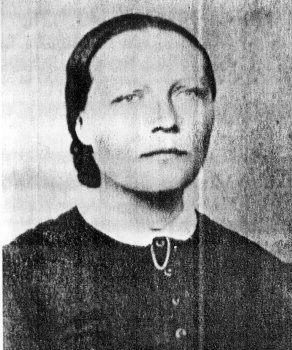
various conditions and be moderately happy. My mother was very attractive in
her youth. Her black hair, blue eyes, and slender figure perhaps drew more than
one admirer; nevertheless, she married an ordinary farmer and fisherman from a
neighbor island when she was 24. I did not remember her before she was about
40, so I missed some of her youthful glamour. But her deep-rooted concern and
profound love displayed at middle age were more than skin-deep. 1 loved my
mother very much.
After
my parents married they settled at Nord-Solver, Father's birthplace, where they
built a home and lived for several years. My brother, Johan Kristian Hansen,
and my four sisters, Kristine Marie Hansen, Hilda Johanna Hansen, Nilsine
Parelie Hansen, and Anna Eline Hansen were born there. My father depended on
fishing, but this was not sufficient to meet the demand of an increasing
family. After 12 years of marriage my father sold his home to his younger
brother, Johan Edward Jorgensen, and leased half of the island of Kvitver from
a wealthy landowner. It is likely that my mother favored this move because her
brother leased the other half of the island, and it was her home island. The
buildings on the farm were all dilapidated, and to rebuild and repair them took
many years. Both farming and fishing were in many ways an advantage to the
Family. The farm was large enough for planting barley and potatoes. They
generally kept four milk cows, a dozen sheep, and one half a horse; that is,
they had a horse together with the neighbor. The farming gave very little in
cash, but there was a prestige to being a farmer and a fisherman that was
always used in connection with any records of the church or in census records.
My father paid 200 kroner in cash (about seven kroner to a dollar), and 20
kroner each year for the lease of half of the island of Kvitver. There was no
distinct marker between the farms. My uncle knew the dividing line, and he was
not greedy.
My parents were striving hard to support their family and to meet their financial obligations honorably. This we knew perfectly well, so we had high regard for one another in the family. But it was hard work always for every person, without dispute between each other.
|
|
|
|
Birth
and Infancy
One
year after my parents moved to Kvitver, I was born. That I remained the last
child in the family cannot be blamed to an indifferent attitude, because my
mother had six children, and was then 37 years old. She told me that I was born
on the last day of May, l883, and she
ought to know. There was no medical help on our island, so a midwife was
therefore fetched from another larger island. Had it been in the winter, help
would be uncertain, but in May it was different. A small boat fluttered over
the waves by rowing or sailing, and returned in less time than expected. The
day is long enough in May to eat supper, read the evening prayer and retire in
bright daylight. The praying was often but a sigh, or a sincere wish, but why
bother providence with so many small items which they could do themselves.
However, now they were grateful that all went well. I was at least a normal
child, and a change from four girls in succession. It is wonderful how life is
preserved from birth, even with such limited medical assistance. To tie and to
cut the umbilical cord and then cover the child's navel with a bandage was the
important part of the medical help applied. But all went well with mother and
child, at least in this case.
My
mother nursed her children at the breast, and if this was not sufficient a
nipple made of cloth containing sweet, mushy ingredients was an ordinary
substitute or aid in the process of nutrition. Whether this method should be
considered strictly sanitary is a medical problem and ignored or unknown by my
parents.
At
the age of three months, I traveled seven miles in an open boat to be
christened in the Lutheran Church. According to their belief this was very
important. If a child was sickly, and could not be taken to church, baptism
could be done at home then recorded later in the church record. My godparents
accepted with pride the full sponsorship, which was not just a momentary
display at the aisles of the parish church but an obligation to care for the
child if needed, and to teach it the Christian religion. My full name, Konrad
Johan Zahl Hansen, was selected by my mother according to her best decision.
In
spite of all precaution, I was at first considered a puny child. Mother nursed
me carefully, yet I maintained that slender, long-legged appearance which is
common among puny children. We feared the long winters, as the cold wind
penetrated our home. The coffee in the kettle froze solid overnight, which was
our thermometer. My mother manufactured our clothes of wool and plenty heavy.
The beds were deep enough for a straw mattress, a blanket, and on top a
sheepskin quilt with the wool down. All clothes for the children were homemade
by my mother, so during the dark winter season the work indoors consisted of
carding, spinning, weaving, and knitting. My father repaired fishing nets and made
new ones. He also made wooden shoes for everyone in the family, so during the
winter our home was a workshop. We had plenty of space, as the living room was
large enough for a loom, a spinning wheel, and for stretching out the fishing
nets. My parents never worked on Sunday, so all work had to be done on
weekdays, except the chores on the farm which were daily requirements. Sunday
was the day of rest, and was often celebrated by delicious food and religious
worship.
Childhood
As
a child I was safe around the house and on the farm, and there was plenty of
space for playground, so I did not cause my parents much anxiety as I roamed
around. Our home was built in the center of the island, and from the home to
the boathouse was a rocky trail, uninviting to a small child. But as I grew
older the long beaches with pebbles and sea shells attracted me. Nature
provided for our entertainments. In sailing my toy boats I preferred the ponds
rather than the ocean, as I had the sad experience of losing a toy boat on the
ocean. When the winter froze the ponds, we practiced ice skating. We made our
skates of discarded scythes which were fastened to a board and strapped to our
shoes. Often I would toss myself prostrate on the ice and gaze at the ice
crystals in the translucent floor. It was a healthy sport, and we enjoyed it.
Over the summer months we picked many kinds of berries, and we also hunted
eggs, as there were many varieties of sea birds. The eider ducks were most
valuable, because they produced both down and eggs. We always left two nest
eggs, so the birds would be sure to hatch at least one. Otherwise, they might
not return the next year. The midsummer festival was celebrated with a huge
bonfire at the top of the highest hill. In the past the windward side of the
summer stable was selected and empty tar barrels were burned. The smoke would
then disinfect the stable from any evil omen, but we chose the highest hill for
display to compete with other islands which took part in the celebration. The
summer nights in the arctic were enchanting. The east breezes fanned a fresh
odor from the pine forest of the mainland which we indulged in at that time of
the year, as the smaller islands are void of any forest.
One
of my first responsibilities was to herd cows, as there was not any fence
around the fields. There was plenty of pastureland on the hillsides and over
the meadows. My youngest sister was my companion. In the noon hour we drove the
cows over a sand bar to a small island while we went home to lunch. At high tide
the cows had to swim or wade across the bar. We had a horse to pasture, but it
chased the cows, so when the planting was done, we swam the horse to another
island. This was our rodeo. The horse was led by a small boat, but when the
boat returned, the horse swam back to the main island. After a couple of trips,
though, the horse settled down. There was plenty of feed and water in the new
pasture. We also pastured sheep on several islands, but they became shy and
were hard to catch later.
The
summer was short, and we were busy with many things. Fuel for the long winter
was always important. We used peat as a substitute for coal. On certain
hillsides the soil was cut in cubes, then sliced and dried in the sun. We also
purchased wood from sawmills, so we traveled south for 50 miles in a large boat
and loaded it to capacity. This was sufficient for a year supply. These trips
in the summer were always interesting, as they took us through long fjords
where the forest covered the mountains everywhere. The logs were drifting along
the shores, which was not in harmony with our economy. When we came home the
boat was unloaded, and the wood was piled in the boathouse. Everything had to
be under shelter: peat, wood, and fish, as well as all crops from the farm were
inside some substantial shelter to protect them during the winter season.
There
were often things of interest on the islands. Once the Laplanders invaded our
island with several hundred reindeer, and with many trained dogs. They swam the
reindeer across the fjord to our island to pasture them for two days, as the
feed was scarce in the mountains. Perhaps they overestimated our pasture. In
parting they swam the reindeer back. The leader was tied to a boat, and the
rest followed in close succession till they arrived safely at the mainland. The
Laplanders are not poor, but they are gifted beggars. My youngest sister and I
retreated to a corner, as we were frightened by the appearance of the
Laplanders and their black dogs.
Winter
sceneries were often fantastic. Once my sister and I roamed over the island,
when suddenly a flickering light spread above the horizon. We were amazed, as
the dark arctic nights are never penetrated by any artificial light. The snow
glittered faintly as the light waves arose to the north and spread towards us.
"Look!"
exclaimed my sister and pressed my hand, "The northern lights!"
We
both gazed at the spectacular waving of the aurora borealis. It flowed like a
tremulous fire with stripes of flaggy sheets in many colors. The light whirled
into fanciful ornaments, then vanished swiftly.
We
had several companions on the island. When my uncle, Mathias Nilsen quit
farming, a new family took over the farm. Laurits and Randine Larsen, from the
island of Lovunden, with seven well-behaved children gave us plenty of good
companions. They were some of our distant relatives, and they were
exceptionally good neighbors.
Uncle
Mathias was over eight years older than my mother but he was able to do
ordinary light work. He was rather of the stern type, In the early morning he
would often feast on cod liver and flat bread, but the other meals had to be
fish and potatoes. He had two boats, one for fishing and the other fur taking
some of us to church. On Sunday morning he walked with long and precise steps to
the boathouse to get the boat ready. He would sometimes wait an hour or more
for everyone to get ready. His boathouses were orderly. When sawing wood he
measured the length with a ruler, then stacked it along the wall.
Uncle
Mathias' wife, Karen Anna Petersen, was a crippled woman, not from childhood,
but from maternity confinements. She was a small woman, and walked on crutches.
She was the much needed encyclopedia and genealogical almanac of the island.
She did not gossip, but could inform one of many things. In my genealogical
research of later years I wished that it were possible to talk to Aunt Karen.
She did not attend church, on account of her crippled condition, but she gave
herself to her neighbors, in particular to us children. If her liberality
afforded but a small cookie to each of us, it was Aunt Karen's gift to the
world without recompense. Neither did she expect any reward, as people were
liberal in our district.
School
Days
At
the age of seven I was sent to school. The teacher, Erland Christensen
Brandser, was my uncle-in-law, as he married my father's sister. He came from
Brandser, Gudbrandsdalen, but was educated at Troms Seminary, at Northern
Norway, and settled as schoolteacher at these islands for the balance of his
life. He knew very little of boatmanship, so when he freighted his equipment
from one island to another the boat often wrecked, and he rescued himself by
swimming. At that time there was no schoolhouse in our precinct, so sessions
were held at farmhouses. The largest home on the designated island was used as
schoolhouse, A long table, resting on crude jacks, was placed in the room, with
one long bench on each side. These tables were slightly warped and knotted, and
had three inches play lengthwise, which created considerable argumentation
during the penmanship period. We took turns pushing the table. The teacher at
the chalkboard held a small mirror above his shoulder to detect the guilty one,
but we watched shyly our chance. The alphabet and the numbers we knew from home,
so we began with reading, arithmetic, penmanship, and behavior. We furnished
our own school supply including all books. Our parents could not always buy all
the books we needed, so we borrowed books from the children at school; however,
they often refused to accommodate us. In spite of those conditions, I managed
to study my lessons each day, so I received good marks in all the subjects.
Only one grade for children from seven to fifteen was in many ways detrimental
to the children, particularly for the younger and the older.
This
was not a boarding school, and we were several miles from home, so we lodged
with a friend or relative who lived on that island, and we furnished our own
provision. We brought with us a large trunk of food, which was sufficient for a
few weeks session, and the family we stayed with furnished us with a meal each
day.
The
school was supervised by the minister of the Lutheran Church, and we studied
the Bible and catechism. We also attended church services frequently at the
Luroy Parish Church. There we met many of our friends. People congregated at
the churchyard, which was also the cemetery, for business propositions, or for
merely leaning on a tombstone while telling fish stories till the toll in the
steeple called them to the interior.
The
cemetery was not a place for gaiety nor for displaying of trophies. Most of the
people attending church services had some relatives buried there, and it must
have reminded them of the sadness of past events. One of the events that I
witnessed was the funeral procession of my uncle's three children. The oldest
son, 22, and the two oldest daughters, one 20 and one 18, sailed a boat and
wrecked, drowning at the same time. To see the three coffins carried along the
road with two men leading the procession and singing a song, and the parents
following after, was the most unforgettable event of my young life. I was then
17, and old enough to notice my uncle and his wife bowed in sorrow, with
tear-stained faces, walking the dusty road to the cemetery. None of the three
children were married, and perhaps have been forgotten long ago, unless the
Salt Lake City Temple records shall testify of our work for them.
My
uncle, Jacob Andreas Jorgensen and his wife, Ane Marie Karoline Pettersen, had
a large family, and during that accident which happened to their children, they
must have grieved very much. They were poor and no help was available, at least
in cash, at that time.
If
anything prevented us from going to church, my father conducted services at
home. The program consisted of singing, praying, and reading of a sermon
written by a minister. These sermons seemed unusually long, but silence was the
only requirement of us children.
At
the age of 15 I graduated from school by attending a six weeks session conducted
by the minister. At the graduation exercises the pupils stood along the aisles
of the church and were questioned by some dignitary in his complete vestment.
The interior of the church was decorated with fresh foliage. The graduates wore
new clothes and received special attention. It was an important day, as I was
then through with school, and the free life of a young man was before me. It is
regrettable that in my reflections afterwards I did not long to go back to
school. Perhaps the method of teaching was not interesting. It may be too that
my association with a crowd was in contrast with conditions at home. My work
was often done in privacy, and my play was sometimes a solitary amusement.
At
the age of 13 I met with an accident. My mother wanted me to chop kindling,
which was everyday work for me. We had some boards from the sawmill which we
used for wood. I wore gloves and the ax was heavy, so I spread my left hand on
the board to keep it in place, and I cut my middle finger nearly off below the nail.
I ran to the house, and Mother put a clean cloth around my hand. My father and
brother and neighbor took me in a rowboat to the doctor. The doctor put me to
sleep by using chloroform, so I felt no pain. The end of the finger was covered
with the skin of the fingertip, and sewed on. The next day I went home with the
arm in a sling, and two weeks later I returned to the doctor. The finger healed
nicely and I had no trouble, but my left hand was weaker, and the middle finger
an inch shorter ever after.
This
was perhaps one of the reasons why I went to the city to learn a trade.
Had
this accident happened at the age of 23 it might have been said that I cut my
finger off to avoid being drafted to war, as I never had any admiration for a
warrior, not even Goliath of Gath, neither was it stylish to be a conscientious
objector in our community. This was my first experience at a community
hospital. Among other advancements, I noticed a nurse make a long-distance call
over the telephone, and she was as much surprised to get an answer as was I.
How words can travel along a wire has always been a mystery, as well as travel
without a wire to objects in motion. The advantage is that we don't have any
trouble with the wire.
Fishing
My
early training was very practical. In the summer I helped my father with
fishing, which was mostly rowing lire boat. The ocean was common property, and
the bottom was well-known to my ancestors from father to son, and had names,
like places of interest in a city. We had no need of navigation, as all fishing
was done with land in slight. The compass was the only instrument in our
possession, and it was seldom used. It was there that I received my early
training. We dealt primarily with nature, and the laws of nature are firm. We
did not sleep at work and let the boat drift. In a boat there is only one inch
between life and death, but in our case it was only half an inch, as the small
boats are built of thin lumber. Where we were fishing the depth was several
hundred feet, and the dread of the invisible was often exaggerated, at least
among children. Think of the myriads of creatures, from a speck to a monster,
that could tap or crush our boat in a second. But fear was not our weakness
generally. Perhaps we were too practical, and were burdened with caution.
However, we were by necessity obliged to work, and the sea was an important
resource, so we became attached to it. The winter was the best season for
fishing. From January to April the cods streamed in from the deep sea to the
shallow water to spawn, and the uttermost islands were therefore headquarters
of the cod industry. The famous fisheries at Lofoten attracted men from the
entire coast of Norway. The island of Lofoten is several miles north of the
Arctic Circle, and the winter has very little daylight. Storms rage
continually, and many sacrificed their life in the struggle for existence.
One
winter I went to a station near my home in company with my brother and our
neighbor boys. The fishing was poor, but the experience was valuable. At a
certain hour each morning the sheriff hoisted a flag, and all sailed at the
same time. Each boat could then protect its own fishing lines from being
interfered with. Most of the boats had a crew of five men, but one boat had
only two. The boat was small, but they were cautious as the fishermen had
learned to be. They sailed in rough sea too, but always with the proper
ballast, and the right canvas. On stormy days we lounged in the cabin. On the
wall hung a barometer, and the men clustered about it several times a day, as
it fluctuated considerably in changeable weather. After three months we arrived
home safely, but with a small profit considering the hard work and the risk.
Fishing
was hard work and I disliked it. I preferred to he employed on the land, but to
change occupation was not possible then. My mother once said that I ought to
learn some thing else, but she could not propose anything then. A higher
education was very expensive, as there was not any free high school. The
tuition alone cost 50 kroner a month. School supply, board, room, and clothing
could well amount to more in cash each month than a fisherman could provide for
in a year, so a higher education was primarily for wealthy people.
So
my urge was to go somewhere else or do something different. It took
considerable courage to leave home without money, but we were located close to
the main sailing route and were in touch with people from a wide area. This
bolstered my confidence in strange people. I was taught good principles, but they
could not be bartered for anything valuable or for cash. My earning at home was
so insignificant that it would scarcely supply me with the most essential
things. My earlier amusement around my home did not attract me now, and some of
my companions had left for other places. So I waited a couple of years for
further development. In youth a year seems an extremely long period, and
impatient as I was, time dragged slowly and tediously.